







Pixel Sundays: Guild Wars – An MMO Franchise That Always Wanted to Be Different

Today is all about one of the great and old MMO franchises, namely Guild Wars. This game was released in 2005, at a time when World of Warcraft was heavily in focus with its subscription model. But ArenaNet consciously wanted to create a counter-design to World of Warcraft with Guild Wars. No monthly subscription as a bold, almost radical business model. This meant you only had to buy the game once, making it significantly cheaper in the long run.
Summary
- Guild Wars 1 – Build Design, Freedom, and Gameplay Identity
- Campaigns instead of Addons – Storytelling in Closed Arcs
- Guild Wars 2 – Dynamic World instead of Instance Thinking
- Expansions and Live Service – Change without Subscription
- The Community Experience – PvP, Guilds, Nostalgia
- Guild Wars Reforged – The Classic in a New Guise
- Conclusion – Guild Wars: An MMO Ahead of Its Time and Relevant Again Today
Furthermore, Guild Wars feels more personal and narrative-driven than classic Open-World MMOs. The game also offers a strongly tactical combat system with a limited skill bar, and you have to plan your builds instead of endlessly collecting new abilities. Additionally, synergies are more important than pure equipment value. There has always been PvE and PvP, which were clearly separated but treated equally. Today we want to look at the whole history from the beginning and see how this franchise is doing nowadays.
Guild Wars 1 – Build Design, Freedom, and Gameplay Identity
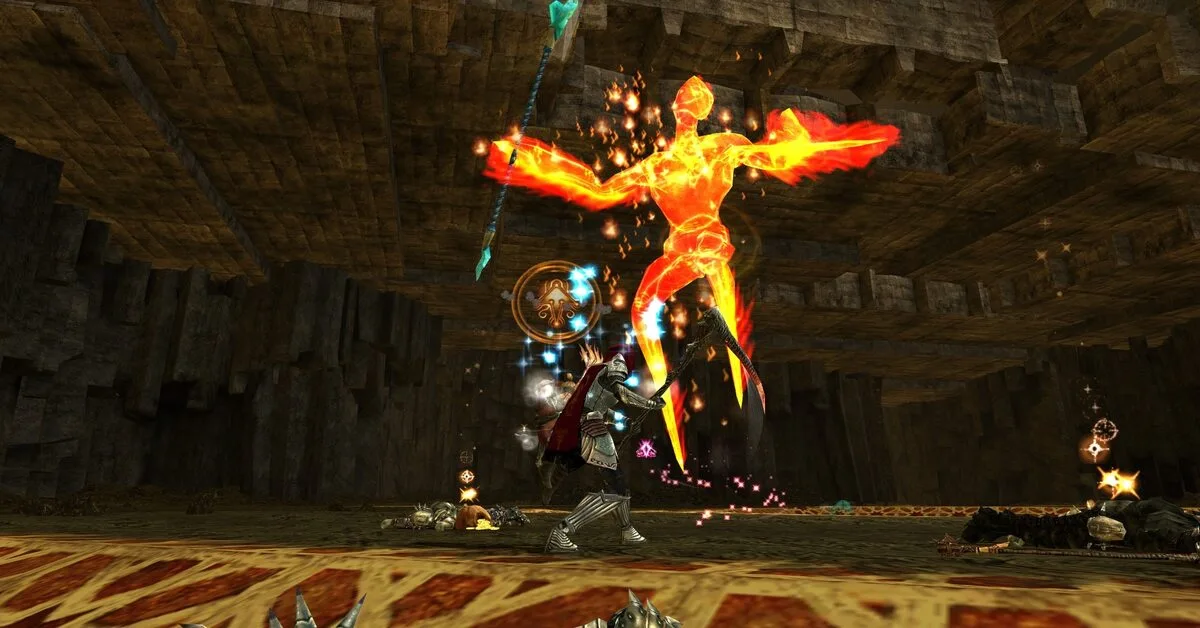
The heart of the gameplay of Guild Wars 1 was the revolutionary skill system. With each of your characters, you can use a maximum of 8 active skills simultaneously. Due to this limitation, you have to play a clear role and make decisions. In total, there are hundreds of learnable skills, but you can always only use a small part of them. Through this limitation, the various item builds moved more into the foreground than levels or skills. In many cases, you had to prepare for boss fights, and this preparation was more important than reflexes or grinds.
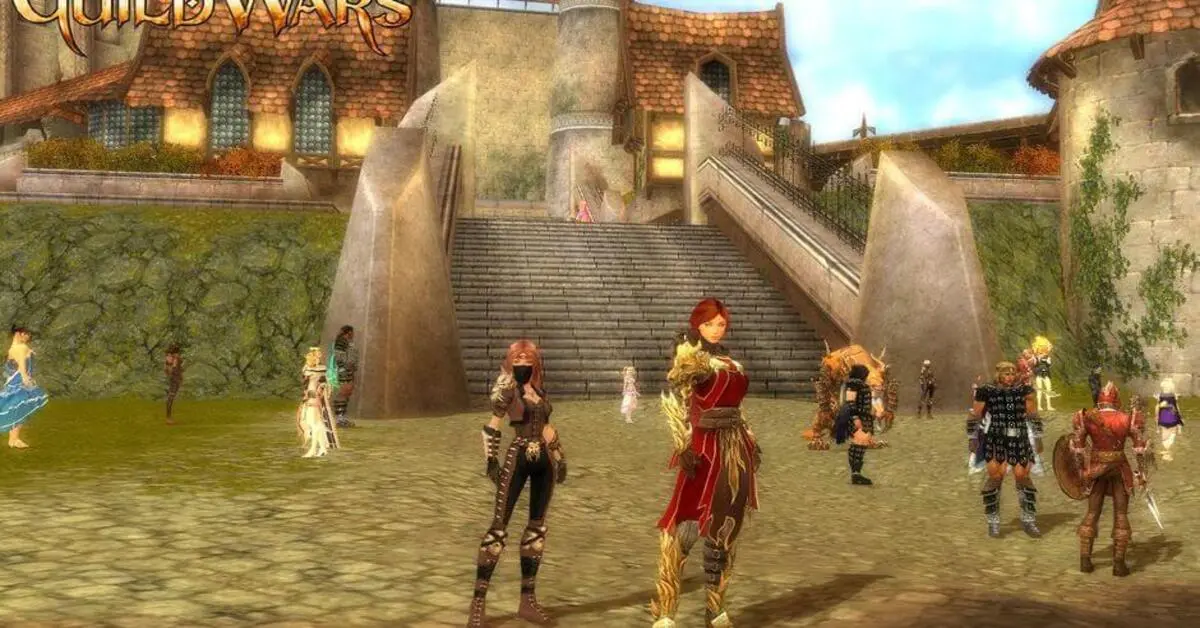
Another design feature was the secondary classes, of which every class can choose one. This creates thousands of possible build variants despite the limitation of active skills. Players actively experimented with roles, support, and hybrid builds. Every player has their own customized build. Of course, there is also a meta that has changed again and again through patches.
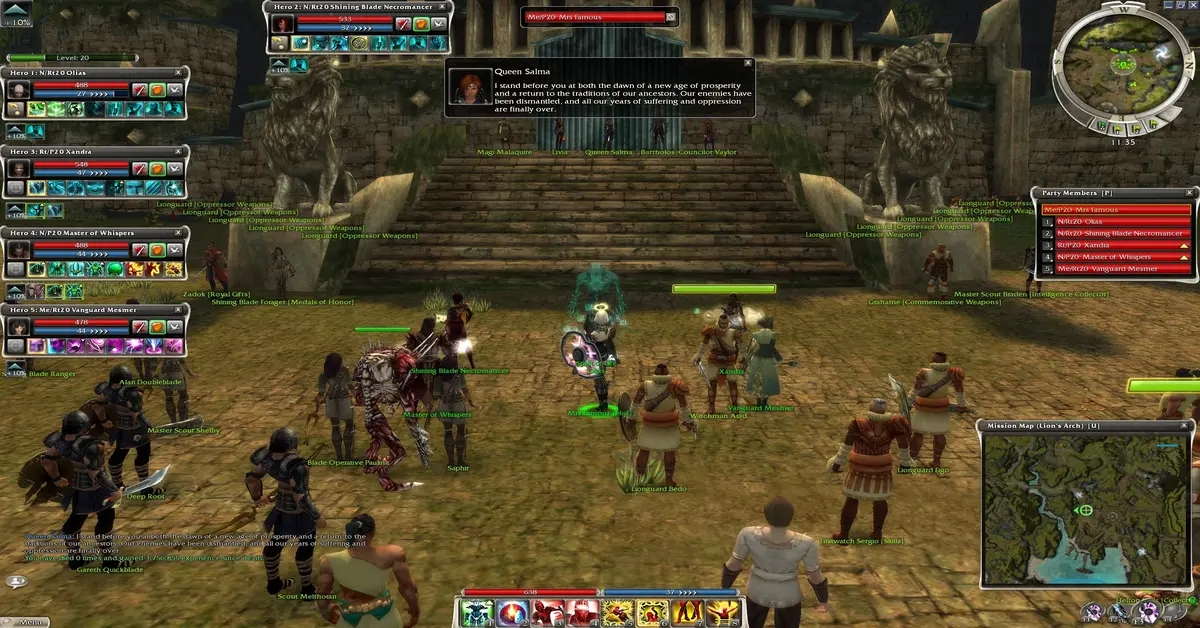
PvE serves as a tactical challenge and not as number progression. The enemy groups had fixed skill sets and clear synergies. To be successful in large battles, you need a good team composition with Crowd Control and the right timing. Classic gear grind played a subordinate role, and endgame content was accessible early on. But PvP was also designed as a competitive core element from the start. There were modes like Guild vs. Guild and Heroes Ascent with a strong focus on coordination, communication, and build tuning. Over time, there were also official tournaments with prize money and rankings, creating an early proximity to later E-Sports.
Campaigns instead of Addons – Storytelling in Closed Arcs
ArenaNet consciously decided against classic addons. Every release was a standalone campaign with a beginning, middle, and conclusion. You could start and play the campaigns independently of each other. But there is also no compulsion to catch up on older content to be current. The big expansions were Prophecies, Factions, Nightfall, and Eye of the North. Prophecies is about a classic High Fantasy narrative with a long introduction, a strong hero’s journey, and a focus on world-building. In the DLC, you are introduced to Tyria as a credible new setting.
Then Factions appeared with Asian-inspired cultures and political conflict. This DLC has a significantly faster progression pace and a strong focus on faction combat and urban spaces. Thematically more gray instead of classic Good against Evil. With Nightfall came the most narratively ambitious campaign. It has a dark tone with stronger character drawings; in the DLC, heroes are introduced as controllable NPC companions. Furthermore, the story is more strongly interwoven with gameplay systems.

The last DLC released for Guild Wars was Eye of the North as a connecting epilogue. You return to known places again, and it serves as preparation for Guild Wars 2. This expansion relies on nostalgia instead of escalation as a conscious stylistic device. The focus of the expansions was always on a closed narrative instead of endless content spirals. There were also no artificial extensions through daily duties; you could simply start playing and take breaks as you wanted. Thus, narrative clarity was placed above permanent long-term binding. This binding was not necessary because one was not dependent on a monthly subscription.
Guild Wars 2 – Dynamic World instead of Instance Thinking
Guild Wars 2 was released in August 2012 and marked a conscious radical break with the design of Part 1. The instanced structure also disappeared completely. The goal was a living world that is constantly changing. The focus also shifted from preparation and builds to situational play. A fully open world was introduced with dynamic events replacing classic quest hubs. Content reacts to game actions and can even fail. New meta-event chains also came into the game, connecting entire regions. Added to this is public group play without invitation or role obligation.
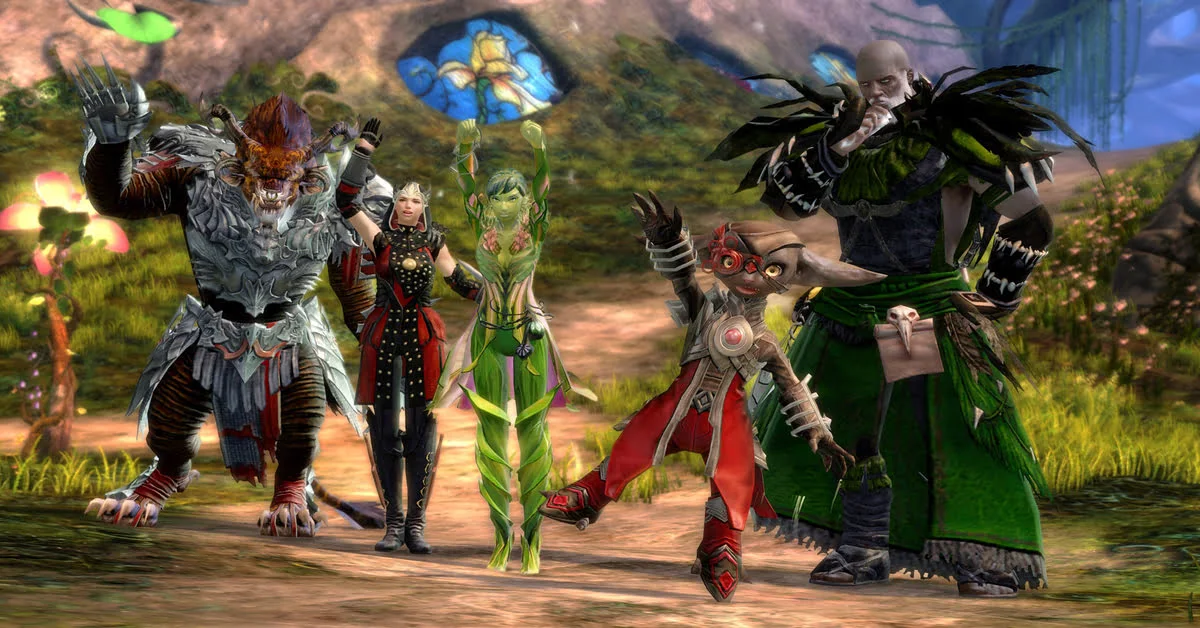
The developers consciously said goodbye to classic quest design. There are Hearts as optional orientation instead of classic task lists. NPC dialogues were also minimized, and you get more info through environmental storytelling. Players were supposed to discover instead of simply grinding tasks. Guild Wars 2 also comes with a new action-oriented combat system, which places a greater focus on movement, positioning, and dodging. Roles are less fixed, and you see more hybrid playstyles. Weapons determine abilities more than the classes themselves. Through all these changes, a significantly broader MMO audience could be addressed.
The gameplay is more accessible and visually exciting. The entry barrier was also reduced for new players. But this also alienated the game from its predecessor Guild Wars 1 and made it seem more like the other classic MMOs, just without monthly costs. The main points of criticism were the loss of build depth and tactical preparation. This created a split between modern MMO success and original design philosophy.

Expansions and Live Service – Change without Subscription
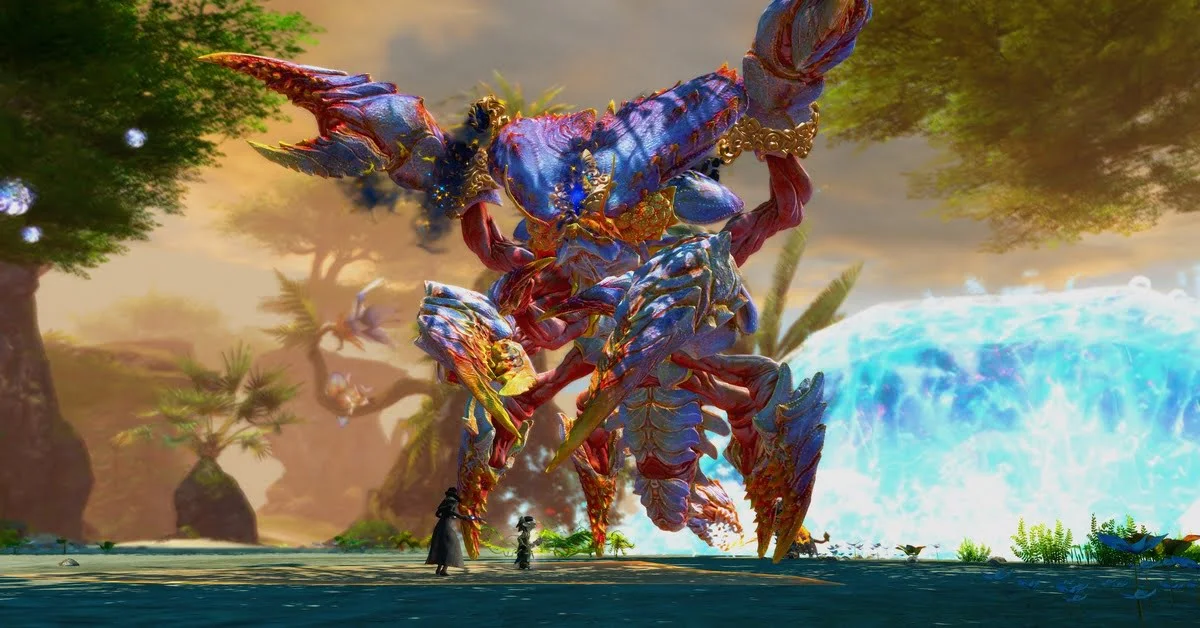
Guild Wars 2 also consistently kept the Buy-to-play model without a subscription. Nowadays the game is even free. Over time, many large expansions appeared which replace classic addons. Heart of Thorns brought vertical maps, Masteries, and Raids. Path of Fire relied on Mounts as a central movement and exploration system. End of Dragons closed narrative arcs and picked up nostalgic elements. So every expansion brought more and improved the game.
These DLCs are paid, but offer a lot of new content as well as increased Level Caps. Elite specializations, new weapons, playstyles, and much more were also added. This also led to a stronger build identity and it became increasingly complex. In addition, there were always some free story episodes for active players, but these were released very irregularly.
The Community Experience – PvP, Guilds, Nostalgia
In the Guild Wars games, there are also guilds where friends meet or groups encounter each other and fight together. Besides Raids and other events, the PvP modes are also very popular. The Guild vs. Guild mode, in which two guilds fight against each other, was repeatedly played competitively. Speedruns and challenge formats were also always gladly done by the community.
Guild Wars Reforged – The Classic in a New Guise
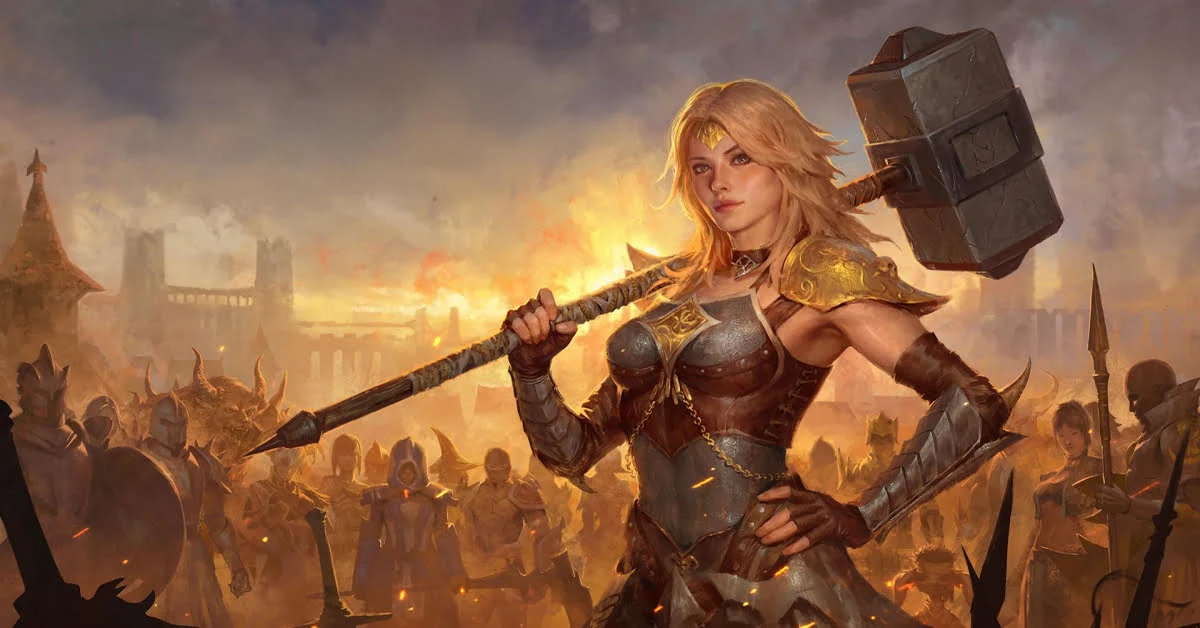
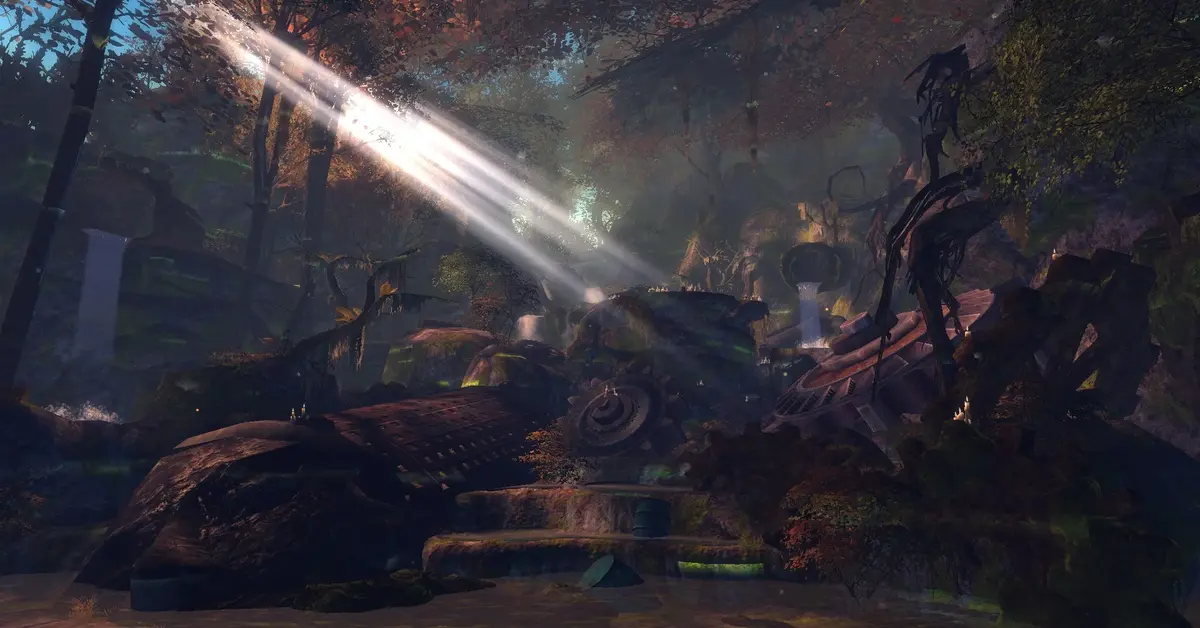
On December 3rd, Guild Wars Reforged appeared as a modernized reissue of the original. The goal was not a reinterpretation, but a careful technical renewal. The focus was clearly on preserving the original game mechanics and balance. Above all, the graphical overhaul is considered a central pillar and a great improvement. There are high-resolution textures, improved shaders, and dynamic lighting effects. But despite all improvements, the original art style was not touched and left exactly as it was. So there is a technically modern impression, but no complete redesign.
The UI was also redesigned and adapted to today’s standards with scalable interfaces and clean DPI support. In addition, quest tracking was improved and menus made clearer. There were also some QoL improvements without simplifying the game depth. Furthermore, Guild Wars Reforged offers full controller support including Steam Deck verification.
Guild Wars Reforged directly includes Prophecies, Factions, and Nightfall in the bundle. Eye of the North deliberately remains separate. The price of the Remastered is also very low. On Steam, the game including the DLCs costs just 20€ and Eye of the North is another 10€ extra. This means basically anyone can look at this old masterpiece on modern standards and invest hundreds of hours into the game. The community reaction on Steam is very positive with 88% positive reviews and players praise the respect for the original. Reforged as a successful example of sustainable classic care.
Conclusion – Guild Wars: An MMO Ahead of Its Time and Relevant Again Today
Guild Wars is more than just an old MMO without a subscription. It is a witness that large online worlds could be thought of differently. Already in 2005, ArenaNet relied on gameplay freedom, tactical depth, and clear design decisions instead of endless grinds and artificial long-term binding. Guild Wars 1 convinced through build variety, preparation instead of reflexes, and a PvP system that placed competence over equipment.
With Guild Wars 2, the franchise consciously dared a break, opened itself to a broader audience, and redefined dynamic Open-World events, but lost part of its original identity in the process. Nevertheless, the Buy-to-play model remained a strong statement against classic MMO subscriptions.
Guild Wars Reforged closes the circle today. It shows that the original design still works 20 years later if it is modernized technically cleanly. Without nostalgia blindness, but with great respect for the original, an MMO experiences a real comeback. Guild Wars thus stands not only for the past but for a rare renaissance in the genre.
Hey, I’m Kilian, but online you’ll probably know me as “Tux1243.” I've been part of the team for almost two years now, always trying to keep you in the loop with the latest and coolest gaming news. I also have a huge passion for doing deep dives and detailed analyses of entire game series and franchises. I love getting to the bottom of things and exploring the little details and backstories that make game worlds so fascinating.
Download the Allkeyshop Browser Extension Free
For all the latest video game news, trailers, and best deals, make sure to bookmark us.
You can find all the best and cheapest online deals on CD keys, game codes, gift cards, and antivirus software from the verified CD key sellers on our store pages.
To not miss any news on Allkeyshop, subscribe on
Google News
.
MORE RELEVANT ARTICLES