














Tomb Raider Legacy of Atlantis Features Lethal Traps and Classic Puzzles with No Hand-Holding

Key Takeaways
- Tomb Raider: Legacy of Atlantis removes modern UI markers, forcing players to rely on historical engineering and visual cues to survive.
- Puzzle designs vary by region, with Greek tombs focusing on mythology while Egyptian chambers emphasize interconnected, mechanical engineering.
- The game launches on February 12, 2027, for PlayStation 5, Xbox Series X|S, and PC, with early access for premium editions.
Rather than relying on modern waypoint markers, the developers are restructuring environmental obstacles around historical engineering and player observation. According to updates published on the official developer blog, the overarching goal is ensuring players understand the mechanical problem before executing a solution.
How Does Tomb Raider: Legacy of Atlantis Redefine Classic Traps and Puzzles?
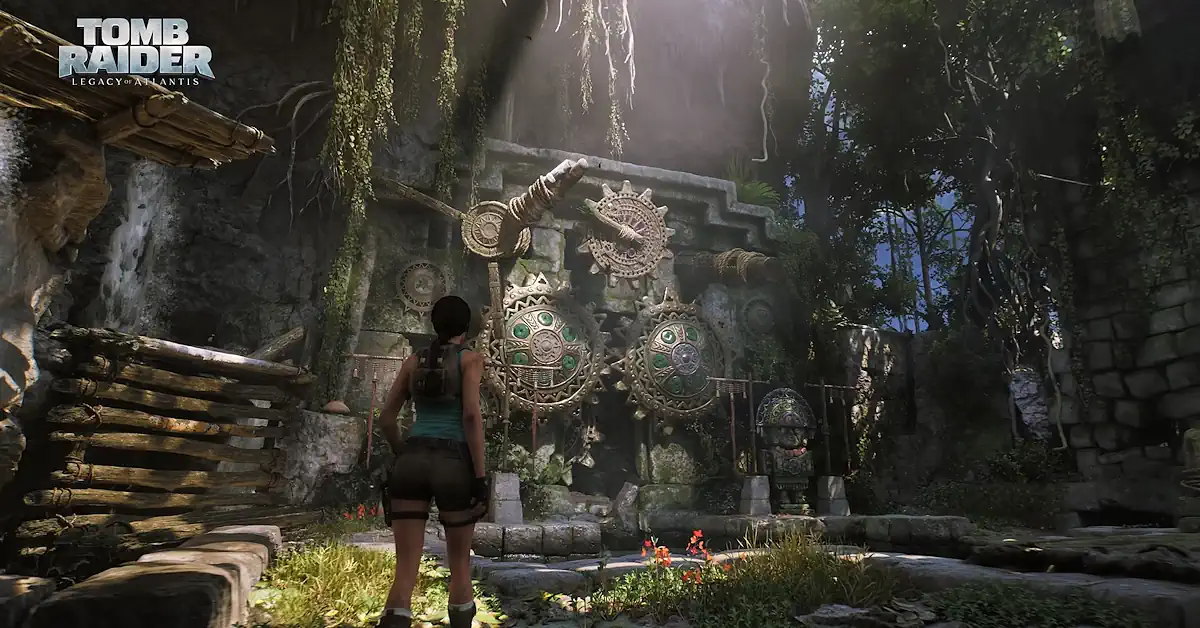
Tomb Raider: Legacy of Atlantis reworks environmental puzzles by grounding them in authentic historical engineering and eliminating intrusive UI markers. Instead of relying on flashing icons, the game forces players to observe ambient visual cues and evaluate mechanical logic.
Players must navigate increasingly lethal trap sequences through organic trial, observation, and spatial awareness. Design Director Jason Epps noted that while early games in the franchise tied puzzles strictly to traversal switches, the upcoming remake embellishes classic sequences.
For example, the Lost Valley waterfall puzzle leading to Qualopec’s tomb has been reworked to offer a deeper mechanical challenge. The engineering team goes through six to twelve revisions per puzzle to remove frustrating bottlenecks while preserving genuine difficulty. The goal is to reward curiosity without causing players to hit an arbitrary wall.
Episode 5 – Puzzles & Traps
— Play Tomb Raider (@PlayTombRaider) August 3, 2026
What makes a great Tomb Raider puzzle?
Ft. devs from @CrystalDynamics and @Flying_Wild_Hog
Watch now: https://t.co/Xn0OXOo8wm pic.twitter.com/O5FUYw6DuJ
Mythology vs. Engineering: Comparing the Greek and Egyptian Trial Chambers
The developer deep dive highlights stark structural differences between the game’s major regions. Each location operates under a distinct architectural philosophy that dictates how traps and environmental obstacles function.
In Greece, puzzle design directly reflects classical mythology. Specific rooms are constructed around individual deities or legendary events:
- The Hephaestus Chamber: Focuses on heat, forge mechanics, and metal manipulation.
- The Poseidon Chamber: Operates as a massive spatial puzzle driven by fluid dynamics and altering water levels over time.
Egypt takes an entirely different approach focused on ancient industrial engineering rather than myth. These chambers utilize complex physical machinery, gear systems, and interconnected mechanisms.
Egypt also introduces large-scale meta-puzzles, such as redirecting a single beam of light across an entire level to unlock hidden central vaults.
Also, learn more about how Tomb Raider Legacy of Atlantis revives the classic acrobatics!
Historical Archaeology and the Elimination of Hand-Holding
Authentic historical artifacts serve as functional puzzle components throughout the campaign. In the Peruvian Lost Valley, players encounter puzzles based on Quipus—an ancient Incan system of knotted cords used for recording data. Players must analyze distinct knot patterns scattered across the environment and match them using mechanical levers.
This commitment to realism extends to environmental hazards. The studio treats traps as lethal executioners that scale in complexity as Lara deepens her exploration. Pressure plates trigger multi-stage mechanisms rather than simple static obstacles.
To reinforce environmental tension, the developers use fallen tomb raiders as visual warnings. Discovering the remains of previous explorers signals upcoming danger zones without relying on artificial screen warnings.
Visual clutter is kept to a minimum. The game avoids glowing objective markers or warning indicators for incoming hazards. While optional scanner hints and Lara’s spoken observations remain available for players seeking assistance, the core experience prioritizes unassisted discovery.
When Does Tomb Raider: Legacy of Atlantis Launch?
Tomb Raider: Legacy of Atlantis will launch globally on February 12, 2027, for PlayStation 5, Xbox Series X|S, and PC. Published by Amazon Games Studios and co-developed by Flying Wild Hog and Crystal Dynamics, the game will release in Standard, Deluxe, and Collector’s editions.
While the separate mainline entry Tomb Raider: Catalyst has been shifted to a later development window, Legacy of Atlantis remains scheduled for its early 2027 arrival. Deluxe and Collector’s Edition purchases will include 48 hours of early access prior to the global release date.
A video game enthusiast ever since I first got my hands on a Game Boy. Over the years, I've played many different games across various genres, discovering hidden gems and niche titles along the way. I'm also passionate about technology, always up-to-date with the latest news and insight in the PC and Console market. Ready to share and bring you the latest news !
Download the Allkeyshop Browser Extension Free
For all the latest video game news, trailers, and best deals, make sure to bookmark us.
You can find all the best and cheapest online deals on CD keys, game codes, gift cards, and antivirus software from the verified CD key sellers on our store pages.
To not miss any news on Allkeyshop, subscribe on
Google News
.
MORE RELEVANT ARTICLES




Comments (0)