











Pixel Sundays: Stellaris – The Endless Story of Your Own Galaxy

In today’s Pixel Sundays article, we delve into the vast expanse of space. Stellaris captures exactly this fantasy. However, Stellaris does not dictate a rigid storyline; instead, you write your own history. You control your own empire, comprising various star systems, and make critical decisions on a political, military, and scientific level.
Summary
- The Beginning – Stellaris and the Dream of Your Own Empire
- Gameplay – A Blend of Strategy and Story Generation
- DLCs and Evolution – From a Solid Start to an Industry Titan
- Influence on the Genre – Stellaris as the Modern Sci-Fi Standard
- Stellaris Today and Tomorrow – An Endless Universe
- Conclusion – A Game That Writes More History Than It Tells
The game can be paused at any time and follows a broad structure that remains consistent across every playthrough. Initially, you must explore, then colonize, utilize your resources, expand, and hopefully triumph in armed conflicts against rivals. Stellaris offers a compelling mix of strategy, storytelling, and sandbox elements. Today, we discuss why Stellaris remains highly relevant years after its release. Additionally, we examine its development, gameplay, narrative capabilities, and profound influence on other titles in the industry.
The Beginning – Stellaris and the Dream of Your Own Empire
Stellaris launched on May 9, 2016. It was developed and published by Paradox Interactive. Paradox is renowned for its grand, highly complex strategy games, including acclaimed titles like Europa Universalis and Crusader Kings. While these games are typically grounded in a historical framework, Stellaris is set in the distant future, stripping away historical constraints. Consequently, the developers enjoyed absolute creative freedom in shaping their sci-fi universe.

At the onset of your campaign, you meticulously design your own interstellar empire from the ground up. You can select from various species phenotypes, including humanoids, reptilians, machines, or even sentient planetary bodies. Furthermore, you must define your empire’s ethics—ranging from pacifist or militarist to xenophobic, egalitarian, and more. You also dictate the form of government, whether it be a democracy, oligarchy, imperial regime, or hive mind. These foundational decisions fundamentally alter your playstyle, introducing a profound role-playing aspect that was unusually direct for a Paradox title.
Upon starting the game, you possess a small home planet and a modest fleet. Your initial objective is to survey nearby star systems and establish colonies on habitable worlds. You can construct diverse facilities on your planets for production, or deploy mining stations directly orbiting uninhabitable celestial bodies. Your scientists, commanding research vessels, will investigate anomalies, ancient ruins, and mysterious signals. A multitude of events are randomly generated, ensuring constant surprises and narrative tension.
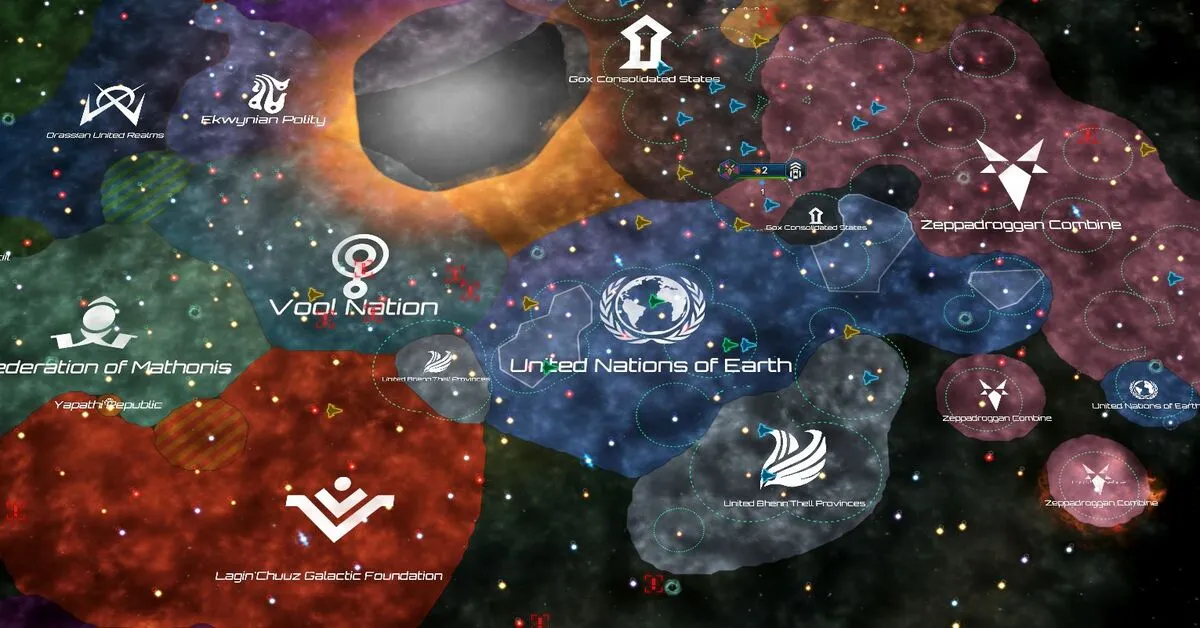
Throughout your exploration, you will inevitably encounter other civilizations, approaching them with either hostility or diplomacy. These interactions lay the foundation for alliances, intense rivalries, and sweeping galactic conflicts. Upon its initial 2016 release, the game placed a heavy emphasis on atmospheric world-building and conceptual depth. However, it also faced some valid criticism: the mid-game often felt barren, and the end-game lacked variety. Diplomacy and internal politics were also comparatively simplistic at launch. Nevertheless, the opening hours were universally praised as incredibly captivating, with the exploration mechanics and story events receiving particular acclaim.
Gameplay – A Blend of Strategy and Story Generation
At its core, Stellaris adheres to the classic 4X paradigm: Explore, Expand, Exploit, and Exterminate. In the context of the game, you begin by surveying the systems surrounding your homeworld in search of valuable resources and habitable planets. Subsequently, you expand your territory by founding new colonies. Resource management follows, requiring you to balance energy credits, minerals, research output, influence, alloys, and more. Ultimately, you will either wage war or navigate diplomatic channels to increase your dominion or defend your borders. Unlike turn-based strategy games, Stellaris unfolds in real-time, though it can be paused at your discretion. The decisions you make frequently carry long-term economic, political, and military consequences.
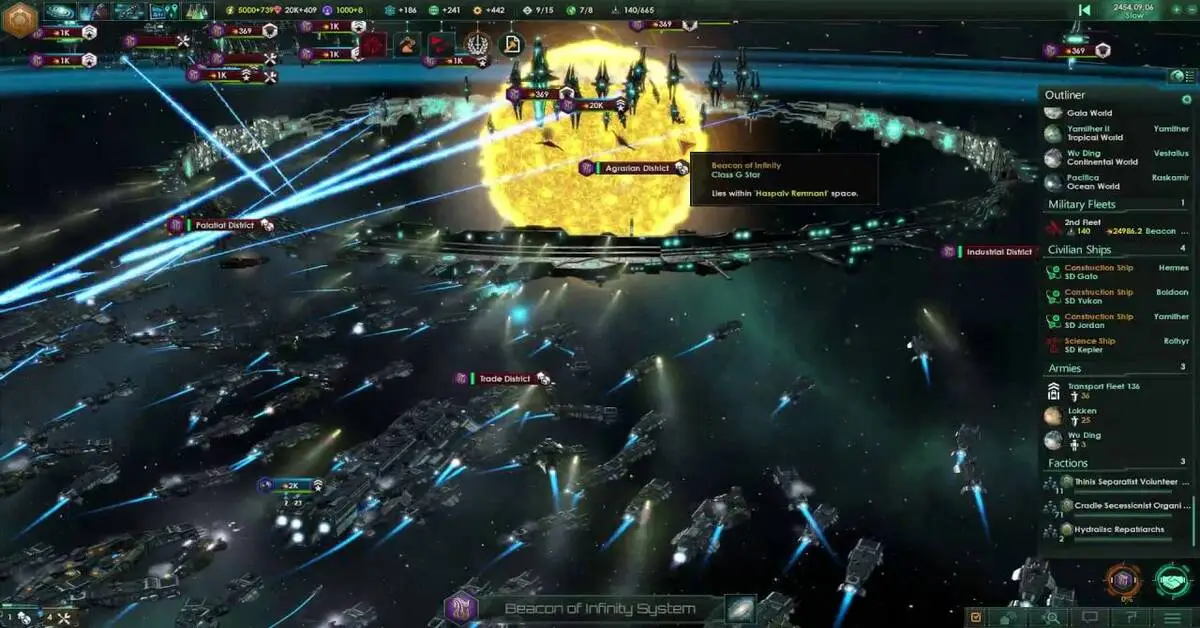
The greatest strength of Stellaris lies in its dynamic event system. Instead of a linear narrative, random and often astonishing occurrences manifest organically throughout your playthrough. You might encounter colossal space dragons capable of obliterating planets, or face galaxy-wide crises. Every session features, for instance, Fallen Empires—highly advanced, stagnant civilizations that boast significantly greater power than any emerging empire at the start of the game. Furthermore, opening dimensional gateways can unleash unforeseen threats, among countless other possibilities.
Towards the mid-to-late stages of every campaign, a global crisis emerges. This could range from a devouring swarm intent on consuming all galactic life to the sudden rise of marauding pirate lords. Defending against these cataclysmic events is paramount, frequently requiring multiple empires across the galaxy to forge uneasy alliances. The end-game crisis serves as the most critical juncture of a playthrough and, for many, marks the definitive climax of a session—though you are entirely free to continue managing your empire indefinitely.
DLCs and Evolution – From a Solid Start to an Industry Giant
Since the release of Stellaris in 2016, the game has been in continuous development. Paradox Interactive follows a typical long-term strategy, delivering major DLCs alongside free updates. These updates frequently bring comprehensive reworks to existing systems. As a result, the game has massively evolved and expanded over the years. Currently, there are 32 DLCs available; while some merely introduce new species, others implement entirely new gameplay mechanics.

However, this DLC model has often faced criticism. To get the full experience, you essentially need all the expansions. But if you are a new player picking up every DLC at once, it can feel completely overwhelming. Naturally, purchasing 32 DLCs is also highly expensive, which is why Paradox offers a subscription model to rent the expansions. This allows you to experience the game with all DLCs unlocked for a month, for example.
Let’s briefly go through some of the major expansions to give you an idea of their scale. It started with Utopia in 2017. This DLC introduced megastructures like Ring Worlds and Dyson Spheres. Dyson Spheres harness the power of a star to generate massive amounts of energy, while Ring Worlds drastically expand habitable space. It also introduced Ascension Perks for individual empire specialization. Apocalypse in 2018 brought Titans as massive warships and Colossus superweapons capable of destroying entire planets. The Federations DLC in 2020 significantly expanded diplomacy, introducing a galactic senate and far more complex alliance systems.
But the free updates have also brought fundamental changes to the game over the years. The economic system, for instance, has been overhauled multiple times, shifting from simple numbers to complex production chains. The Pop system (population) was also significantly deepened. Pops now have a far greater impact on your economy, stability, and planetary development. Planet management was another crucial focal point; various districts and building slots were introduced, offering deep strategic choices instead of basic administration. All of these core changes arrived for free via updates.

Impact on the Genre – Stellaris as the Modern Sci-Fi Standard
With its release in 2016, Stellaris not only delivered a highly successful game but also permanently transformed the sci-fi strategy genre. Its influence on modern 4X and grand strategy titles is particularly undeniable. Stellaris has significantly contributed to integrating deep storytelling into strategy games. The event system, in particular, became a genre-defining feature. It generates dynamic, emergent narratives rather than relying on static campaigns. The focus also heavily shifted toward making decisions that carry real narrative weight. In general, sci-fi grand strategy games surged in popularity, favoring massive, procedural galaxies over rigid historical maps.
Stellaris Today and in the Future – An Endless Universe
Even 10 years after its launch, Stellaris remains an actively played strategy heavy-hitter with over 40,000 daily concurrent players. Developer and publisher Paradox continues to regularly deliver major updates, new DLCs, and extensive balance adjustments. Alongside the official expansions, a key factor in the game’s incredible longevity is its massive modding community. Players have introduced custom species and factions, unique story chains, and total conversions featuring entirely new universes or iconic sci-fi settings. Thanks to these mods, you can easily sink thousands of additional hours into the game.
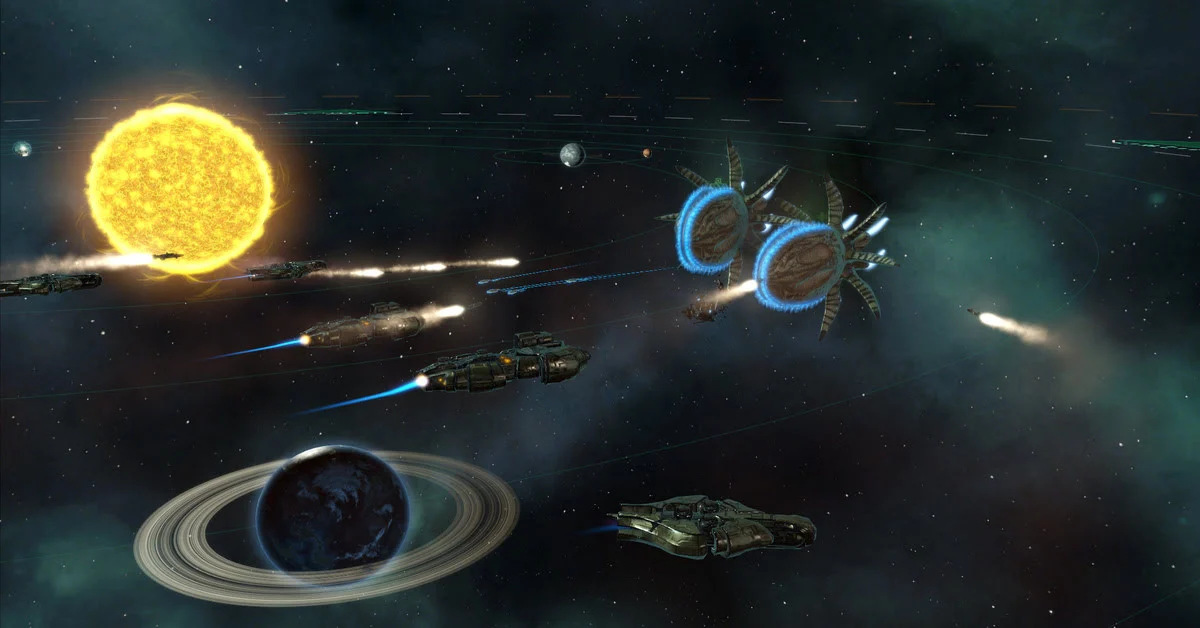
Paradox is well known for supporting its games for a very long time. It is highly likely that more DLCs and updates are still on the horizon. These updates could bring further systemic improvements, such as essential late-game performance optimizations. Diplomacy, internal politics, and faction mechanics could also see further expansion. Additionally, new story elements and endgame crises are highly probable moving forward. A Stellaris 2 has not yet been announced and is nowhere in sight. You should not expect a direct sequel before 2031 at the earliest.
Conclusion – A Game That Writes History Rather Than Telling It
Ultimately, Stellaris stands as a prime example of how a title can captivate players not through a predetermined script, but through absolute player freedom. Every match develops differently, every single choice can have long-lasting consequences, and it is precisely from this framework that unforgettable, emergent stories arise. The sophisticated blend of classic 4X strategy, role-playing elements, and a dynamic event system ensures that Stellaris consistently feels fresh, even after hundreds of hours of playtime.
Despite justified criticism regarding its expensive DLC model and the steep barrier to entry caused by its complexity, the game has undeniably evolved into a true titan of the strategy genre. Thanks to continuous developer support, an incredibly active modding community, and Paradox Interactive’s clear long-term vision, Stellaris will undoubtedly remain relevant well into the future. If you are willing to dive in, you won’t find a simple game here, but an expansive sandbox where you forge your very own sci-fi saga—and that is exactly what makes Stellaris an absolute masterpiece.
Hey, I’m Kilian, but online you’ll probably know me as “Tux1243.” I've been part of the team for almost two years now, always trying to keep you in the loop with the latest and coolest gaming news. I also have a huge passion for doing deep dives and detailed analyses of entire game series and franchises. I love getting to the bottom of things and exploring the little details and backstories that make game worlds so fascinating.
Download the Allkeyshop Browser Extension Free
For all the latest video game news, trailers, and best deals, make sure to bookmark us.
You can find all the best and cheapest online deals on CD keys, game codes, gift cards, and antivirus software from the verified CD key sellers on our store pages.
To not miss any news on Allkeyshop, subscribe on
Google News
.
MORE RELEVANT ARTICLES