






![MotoGP 26 drops this April with a massive Switch 2 debut [Leak]](https://www.allkeyshop.com/blog/wp-content/uploads/featured-moto-gp-2026-26-milestone-playstation-leak-confirmation-editions-details-172x90.webp)
![Get 11 Highly-Rated Steam Games for $0.00 Right Now [Free Games]](https://www.allkeyshop.com/blog/wp-content/uploads/featured-steam-free-games-freebie-indie-adction-adventure-cozy-novel-haven-free-172x90.webp)



Pixel Sundays: Avatar: Frontiers of Pandora – From Screen to Console

Avatar has been a massive franchise since James Cameron’s first film in 2009, known for its iconic, vibrant world and deep ecological themes. At the time, the visual immersion of Pandora was a milestone in blockbuster cinema. Precisely because this film world is so detailed and technically demanding, no one expected a video game to truly do it justice.
Summary
- Avatar as a Franchise – More World than Story
- From the Big Screen to Open World – Pandora’s Digital Translation
- Gameplay – Life as a Na’vi instead of Playing as a Tourist
- Immersion as Core – Seeing, Hearing, Feeling
- Ubisoft DNA vs. Avatar Identity
- Avatar: Frontiers of Pandora From the Ashes – When Pandora Lives On
- Significance for Movie Adaptations in Gaming
- Conclusion – Pandora Works Without the Cinema Screen
But in 2023, Avatar: Frontiers of Pandora was released and proved everyone wrong. It successfully made the leap from the big movie screen to PCs and consoles. However, the game doesn’t just retell the movie; it offers a genuine open-world experience in a vast game world. But how well does this transition from cinematic blockbuster to interactive open-world experience succeed? We clarify that today.
Avatar as a Franchise – More World than Story
Avatar from 2009 and Avatar: The Way of Water (2022) are among the most successful films in cinema history, known primarily for their technical innovation and visual impact. The films are set in the near future, where humanity colonizes the alien moon Pandora to mine valuable resources. This moon is hostile to humans, which is why so-called Avatars are used: biologically created bodies that allow humans to experience the world from the perspective of the native Na’vi.
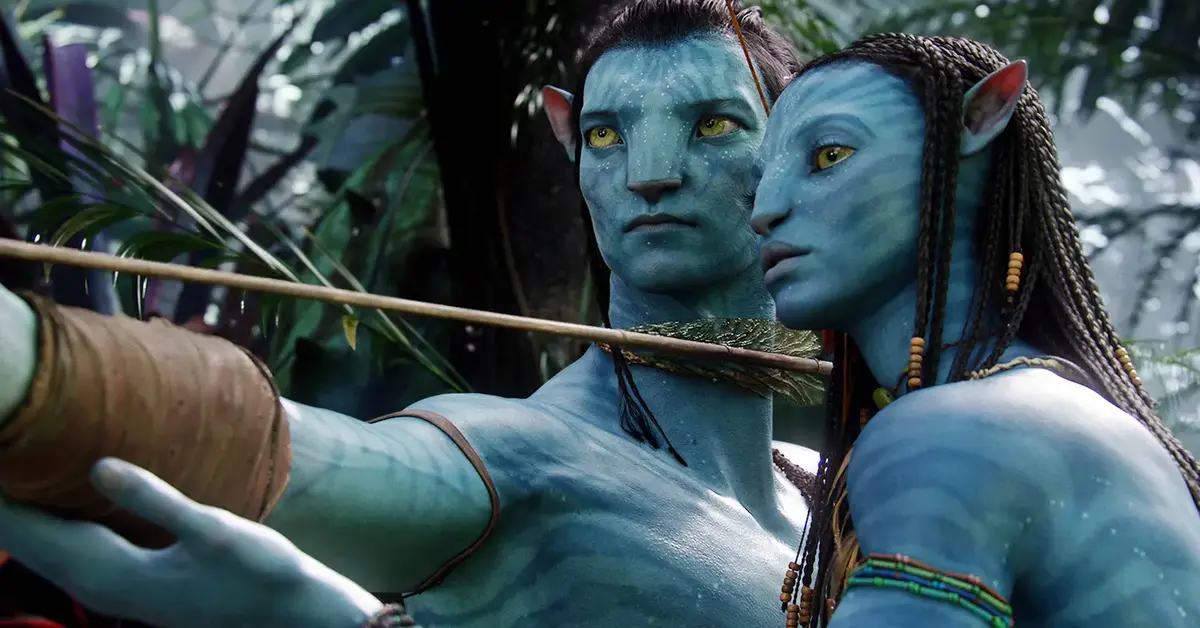
The films revolve around the conflict between technology and nature, exploitation versus coexistence, and immersion in an alien world. The actual plot serves mainly as a vehicle to gradually discover Pandora. The films place a clear focus on world-building, atmosphere, and physical presence. Flora and fauna follow their own rules, react to each other, and convey the impression of a functioning ecosystem.
It is precisely this orientation that makes Pandora particularly predestined for interactive media. Instead of retelling a fixed movie plot, the franchise offers an open playground for its own stories within a clearly defined framework. Currently, the third part of the series, Avatar: Fire and Ash, is also running in theaters, expanding the franchise even further.
From the Big Screen to Open World – Pandora’s Digital Translation
Avatar: Frontiers of Pandora was developed by Ubisoft Massive, the studio behind The Division. Massive worked closely with Lightstorm Entertainment to ensure that Pandora’s design, ecology, and technology matched the films. Instead of a classic third-person perspective, the studio consciously decided on a first-person perspective to create even more immersion. This makes the height, depth, and speed of the world feel much stronger. Especially when climbing, jumping, and later flying, the world seems less like a backdrop and more like a real space.
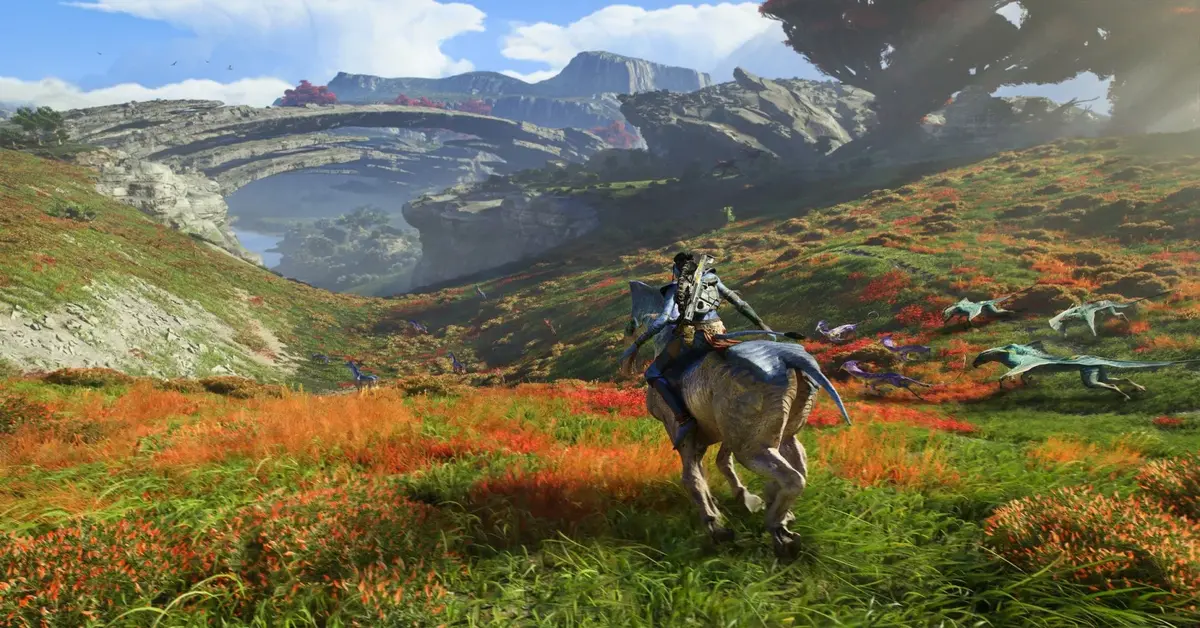
Content-wise, the game sets itself apart from the movie plots. The story takes place in a new region of Pandora, the so-called Western Frontiers, with its own biomes, tribes, and conflicts. You take on the role of a Na’vi who grows up away from the known movie characters and thus gains a unique perspective on the world. This decision allows the developers to use the aesthetic from the films without being tied to a fixed story. So you don’t see iconic movie scenes; instead, personal exploration is in the foreground. You can hunt, move through the world, observe the environment, and understand everything step by step.
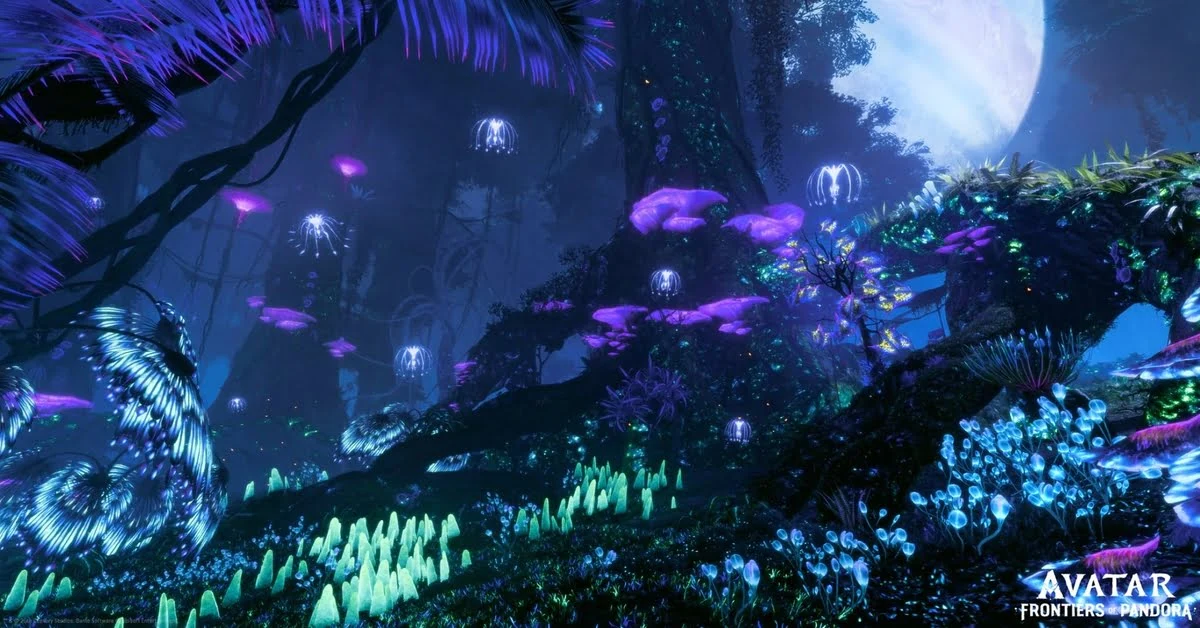
The game runs on the Snowdrop Engine, which is specially known for large, detailed open worlds. Massive used it to combine dense vegetation, wide lines of sight, and strong verticality. The game offers dynamic lighting, volumetric fog, and complex flora systems, making Pandora appear not static, but alive and reactive. The technology serves not only the visuals but supports the central goal: making Pandora experienceable as a walkable, credible world.
Gameplay – Life as a Na’vi instead of Playing as a Tourist
The gameplay is designed so that you are not just an observer, but a part of Pandora itself. The first-person perspective plays a major role in this; it is not a technical workaround but deliberately chosen to give you even more the feeling of being there yourself. Heights, abysses, distances, and speed feel more direct and physical than in third person.
The center of the gameplay is movement. You climb vines, make wide jumps over canyons, glide through treetops, and can later even fly with an Ikran. This provides a strong sense of freedom and verticality, as movement is not just a means to an end, but part of experiencing the world.
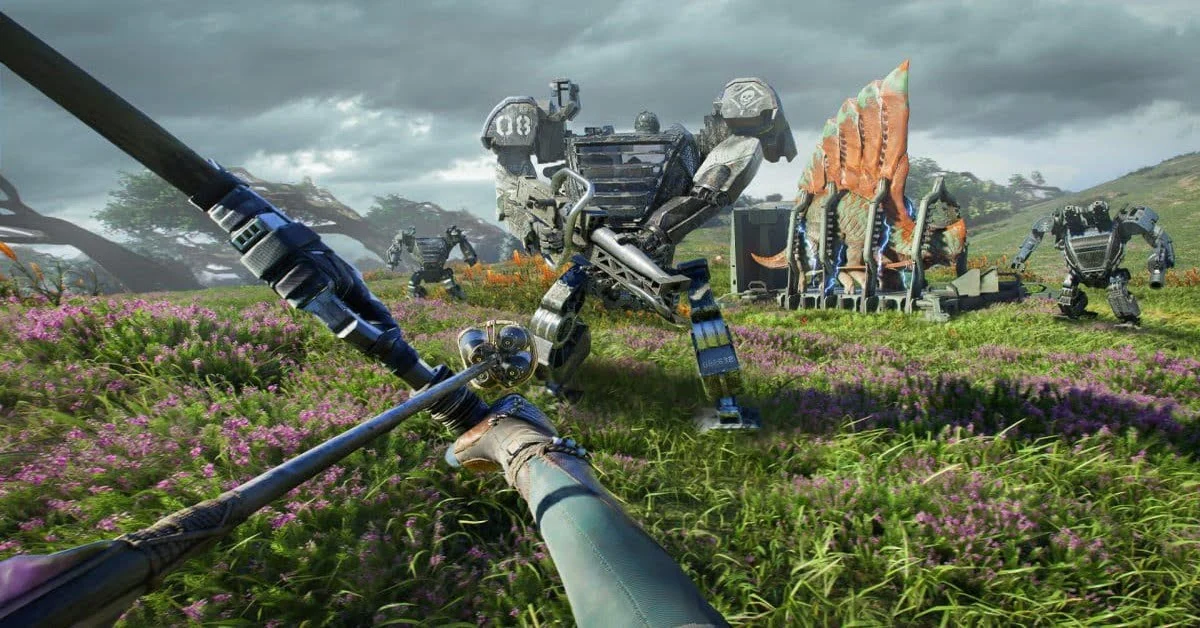
Of course, you also have to fight repeatedly in the game, where there is a clear thematic contrast: nature versus technology. As a Na’vi, you use spears, bows, and improvised equipment, while the RDA (the humans) act with firearms, mechs, and industrial violence. As a result, the fights do not feel like a power fantasy, but more like tactical, situational confrontations where you are the weaker party and can only win through the right tactics. Resource gathering also feels realistic. The game forces you to observe the environment instead of merely farming icons.
Compared to other Ubisoft open-world titles, the game is slower, more grounded, and more reduced. There are fewer checklists, fewer permanent grinding loops, and more focus on atmosphere and presence. Gameplay is understood here not as a permanent challenge, but as a ritual of arrival. You don’t play to conquer Pandora, but to become part of it.

Immersion as Core – Seeing, Hearing, Feeling
Avatar: Frontiers of Pandora relies less on classic game systems than on sensory immersion. The developers want not just to depict Pandora, but to make it tangible. The sound design, in particular, builds a direct bridge to the film world. You can expect alien animal sounds, the rustling of vegetation, distant calls of task forces, or the language of the Na’vi. The music often holds back and steps into the foreground specifically in emotional or spiritual moments, similar to the films.
Flora and fauna do not function as mere decoration but as living systems. Plants react to touch, animals follow their routines, and biomes differ not only visually but also acoustically and playfully. Pandora thus seems less like a map and more like a cohesive organism. Hunting and gathering are also staged calmly and deliberately. It’s less about efficiency, more about attention and timing. The game demands that you read the environment instead of dominating it. So you really live in harmony with nature.

Ubisoft DNA vs. Avatar Identity
Although Avatar: Frontiers of Pandora relies heavily on immersion, you still notice Ubisoft’s signature. There are classic open-world structures with hostile outposts, collectibles, progression trees, and equipment stats, along with side activities. This gives you orientation, but they repeatedly feel like foreign bodies in the Avatar world. Especially markers, loot ratings, or recurring tasks remind you that you are playing a game and not living in Pandora.
However, many of the contents are optional, markers are placed more cautiously, and progress is less trimmed for constant rewards. The game allows for breaks, detours, and moments without an immediate goal. Unfortunately, there is repeatedly a conflict between playful freedom and the cinematic experience. In open worlds, you need repetitions, which doesn’t fit the atmosphere of Avatar perfectly. Not every mechanical decision fits seamlessly with this identity, but some sacrifices had to be made for an open-world game. Especially in action or base scenarios, the experience occasionally tips back into known Ubisoft patterns. Here, Pandora briefly loses its strangeness and feels more functional than mystical.

Avatar: Frontiers of Pandora From the Ashes – When Pandora Lives On
In December 2025, the large expansion From the Ashes was released. This DLC narratively picks up where the basic themes of the main game were already established. It is about the ongoing conflict between exploitation, resistance, and the slow healing of Pandora. From the Ashes introduces a new threat that relies less on pure military superiority and more on systematic destruction. Environmental decay, damaged habitats, and unstable regions move more into focus. The danger is not always visible but permanently palpable.
Narratively, the DLC shifts the perspective slightly; you move away from pure survival towards reconstruction and responsibility. Decisions feel more long-term, actions have visible effects on areas and their inhabitants. Pandora is not just defended but actively reclaimed. Known systems like exploration, crafting, hunting, and movement are deepened, not replaced. New content fits in organically without destroying the existing balance. Also in the DLC, there is no artificial urgency or forced endgame pressure. Instead, From the Ashes invites you to linger once again.

Significance for Movie Adaptations in Gaming
Avatar: Frontiers of Pandora shows a different idea of film adaptation. Instead of just reenacting movie scenes with iconic characters, you enter the known world but far away from the story in the film. The story arises from the place, not from the script. This avoids comparisons with the film, which often creates problems. In the Avatar franchise alone, there is a world that provides material for many different games. But other franchises with unique worlds could also follow this approach in the future.
Conclusion – Pandora Works Without the Cinema Screen
Avatar: Frontiers of Pandora proves that the Avatar universe does not rely on big screens to work. The game understands what makes the films strong and transfers exactly this core into the interactive: world, atmosphere, and the feeling of being part of a living ecosystem. Instead of retelling iconic scenes, it lets you experience Pandora itself, with all its beauty, its danger, and its quiet moments.

Not everything is perfect. The typical Ubisoft open-world structures break the immersion in places and remind you that game systems still have to take effect here. But these weaknesses fade in comparison to the consistency with which Pandora is thought of as a space and not just a backdrop. Frontiers of Pandora does not want to constantly entertain, but to invite, slow down, and let it take effect.
Especially with From the Ashes, it becomes apparent that this concept holds up in the long term. Pandora is not a one-time excursion, but a place that changes, recovers, and evolves. Thus, the game stands emblematic of a new type of film adaptation: less story retelling, more world experience. Avatar impressively shows here that some universes only unfold their full potential when you are allowed to enter them yourself.
Hey, I’m Kilian, but online you’ll probably know me as “Tux1243.” I've been part of the team for almost two years now, always trying to keep you in the loop with the latest and coolest gaming news. I also have a huge passion for doing deep dives and detailed analyses of entire game series and franchises. I love getting to the bottom of things and exploring the little details and backstories that make game worlds so fascinating.
Download the Allkeyshop Browser Extension Free
For all the latest video game news, trailers, and best deals, make sure to bookmark us.
You can find all the best and cheapest online deals on CD keys, game codes, gift cards, and antivirus software from the verified CD key sellers on our store pages.
To not miss any news on Allkeyshop, subscribe on
Google News
.
MORE RELEVANT ARTICLES




Loved the movies and this games world and graphics look top notch. Might be worth the check out based on the spectacle alone.
I didn't expect this movie license game adaptation to be well made.
I haven’t seen the latest Avatar movie, but the game actually looks pretty nice
Nice world, nice ambiance, gameplay is good too and price is not high compared to other games nowadays
Well... i must say i'm not hyped with this game. The movies are not bad at all but still overhyped in my opinion. Graphics of this game are looking good but it may lack of soul and attraction to the casual gamer. No expectations on this nevertheless they can build a good world