














Keys vs. Physical Discs: How Much CO₂ Do You Actually Save in 2026?

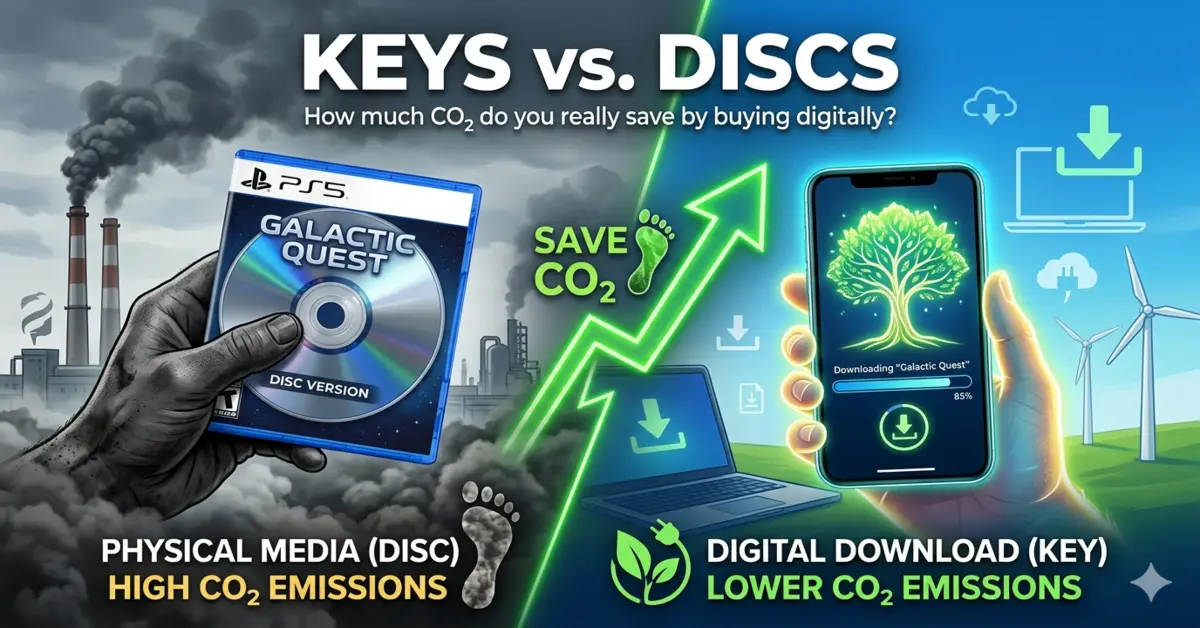
The surprising truth about digital game keys and the environment
In 2026, more gamers than ever are asking themselves: Is buying a game key on a price comparison site actually better for the planet than purchasing a physical disc?
The short answer is yes — and by a very large margin.
A major 2025 study by French carbon accounting firm Greenly delivered clear numbers that shifted the debate. Physical game discs are roughly 100 times more carbon-intensive than digital downloads.
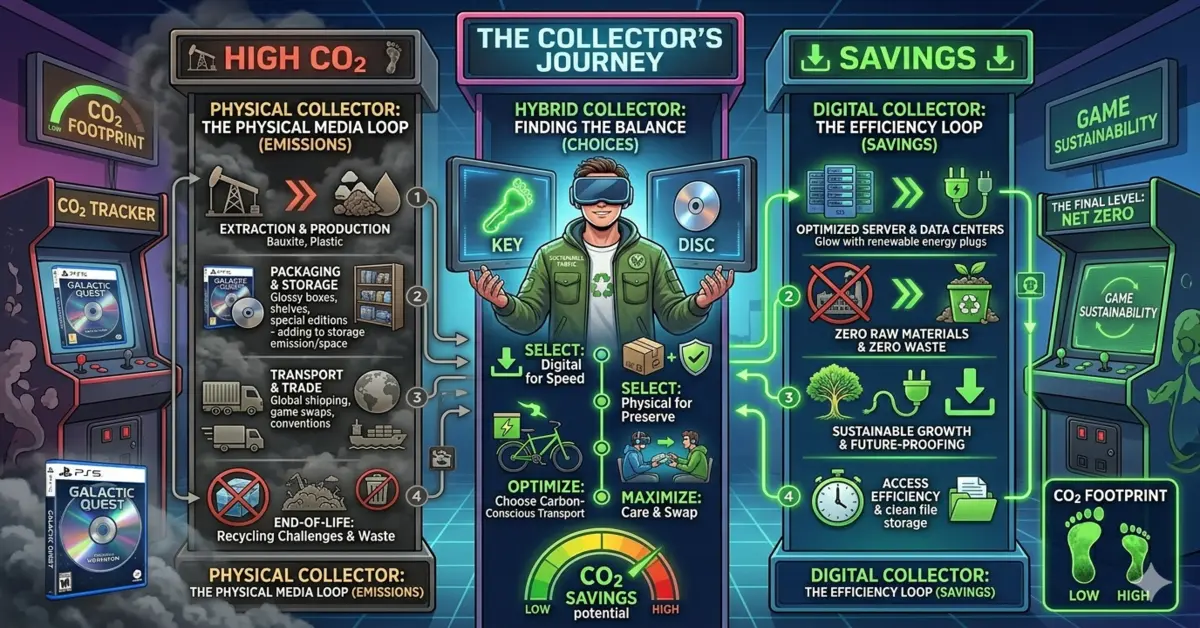
Which type of gamer are you?
-
A) The Physical Collector: Buys discs, keeps them forever (good CO₂ balance due to longevity).
-
B) The Digital Nomad: Only buys keys, downloads at night (when the energy mix is greener), and saves plastic.
-
C) The Hybrid Gamer: Buys AAA giants on disc (due to the 100 GB+) and indie games as a key.
The Hard Numbers: Physical vs. Digital
According to Greenly’s report “The Carbon Footprint of Gaming” (November 2025):
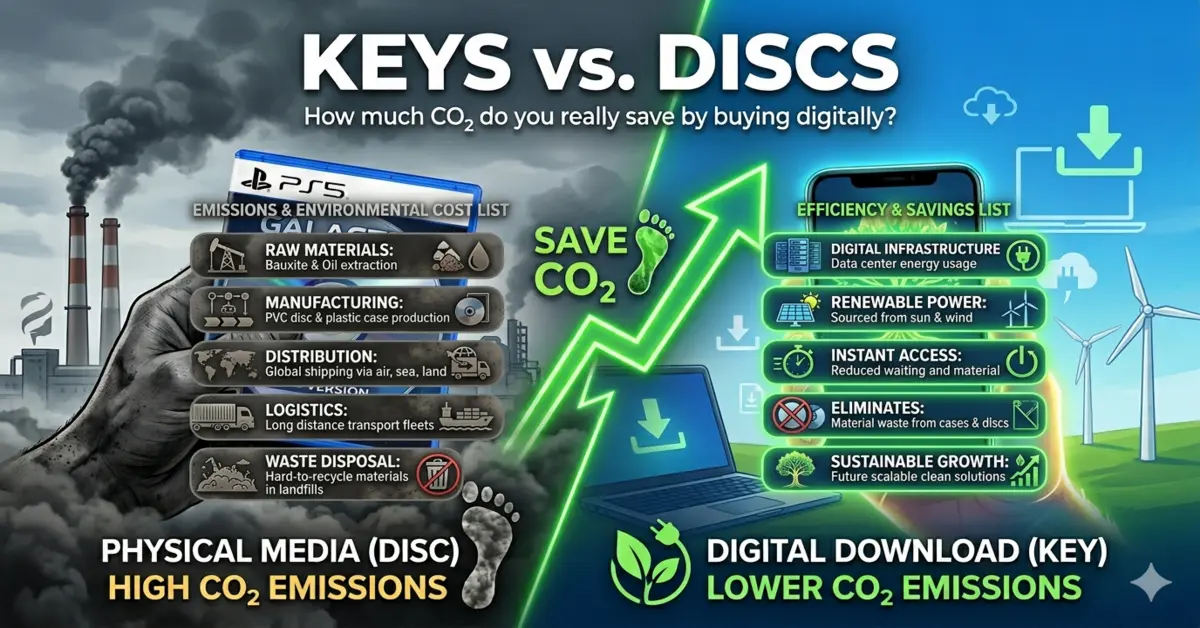
- Manufacturing and packaging 1 million physical discs → 312 tonnes CO₂e
- Downloading the same game (approx. 70 GB) 1 million times → only 3 tonnes CO₂e
That’s a reduction of about 99% in distribution-related emissions when you choose digital.
Note: These figures cover manufacturing, packaging, and transportation. They do not include the actual gameplay phase, which is similar for both versions.
Why Physical Discs Are So Much Worse
Physical games carry a heavy environmental burden:
- Plastic production (polycarbonate discs)
- Energy-intensive manufacturing process
- Packaging (plastic cases, cardboard, shrink wrap)
- Global shipping by sea, air, and truck
- High rate of overproduction and unsold stock that becomes waste
Digital distribution, on the other hand, mainly requires server electricity for the initial download. Modern data centers are becoming more efficient and are increasingly powered by renewable energy.
But It’s Not That Simple – Important Context
Older studies from 2014 (when games were much smaller) sometimes favored physical media. Today’s AAA games regularly exceed 70–150 GB, which completely changes the equation in favor of digital.
Important counterpoints:
- Second-hand market: A physical disc can be resold or passed on multiple times, creating a circular economy.
- Longevity: Physical copies don’t depend on online stores or server availability decades later.
- Cloud Gaming: Significantly worse for the environment than both physical and local digital downloads because of constant streaming.
What Should Eco-Conscious Gamers Do in 2026?
Here’s a practical ranking from most to least sustainable:
- Buy digital keys + install locally (Best overall balance)
- Buy physical and keep/resell it (Good if you actually use the resale market)
- Game Pass / Subscriptions (Convenient, but mixed impact)
- Cloud Gaming (Usually the worst option)
Pro tip: The most sustainable approach is often buying a key during a big sale and playing the game intensively. This maximizes value while minimizing repeated downloads or new physical production.
The Bigger Picture
The gaming industry is enormous. Even small shifts in consumer behavior matter. With physical sales still making up around 25–30% of many AAA titles, choosing digital keys can create real impact — especially when combined with energy-efficient hardware and turning off devices when not in use.
Keys vs. Discs: The CO₂ Balance Sheet (Tabular Comparison)
Green Gaming Action Tips
How to lower CO₂ emissions during the download even further:
- The “Overnight Download” Trick: Schedule your game downloads for the late-night hours. Why? In many regions, the share of clean wind energy in the power grid is significantly higher at night compared to the evening peak hours.
- The “Delete-Diet”: Avoid constantly deleting and re-downloading games just to free up space. Investing in a larger SSD for your PC or console saves CO₂ in the long run by completely eliminating repeated 100 GB+ downloads.
Summary: Digital Wins on Sustainability in 2026
Yes, buying game keys instead of physical discs really does save a significant amount of CO₂. The Greenly study confirms what many suspected: in the age of large game files,
digital distribution is clearly the greener choice.
Next time you compare prices, you can feel a bit better knowing that snagging the cheapest key isn’t just good for your wallet — it’s usually better for the planet too.
Hey, I’m Kilian, but online you’ll probably know me as “Tux1243.” I've been part of the team for almost two years now, always trying to keep you in the loop with the latest and coolest gaming news. I also have a huge passion for doing deep dives and detailed analyses of entire game series and franchises. I love getting to the bottom of things and exploring the little details and backstories that make game worlds so fascinating.
Download the Allkeyshop Browser Extension Free
For all the latest video game news, trailers, and best deals, make sure to bookmark us.
You can find all the best and cheapest online deals on CD keys, game codes, gift cards, and antivirus software from the verified CD key sellers on our store pages.
To not miss any news on Allkeyshop, subscribe on
Google News
.
MORE RELEVANT ARTICLES




Comments (1)
Interesting information. Personally, I never buy disks just because they take up space, and for me, as a minimalist, this is a horror. Plus, keys are way cheaper. But of course, if nobody needs to produce and transport, sometimes on long distances, physical copies, this is a game changer for ecology.